










OUR BLOG
TiltWatch label

Beyond Passive Labeling: Using Tilt Indicators to Secure Fragile Cargo Shipments

Speed is a common warehouse metric, but it shouldn’t come at the cost of orientation for sensitive equipment. A “This Side Up” arrow is passive and easily overlooked, but the TiltWatch indicator is an active deterrent. When vertical stability is a requirement, this label becomes the definitive record of how a pallet was actually handled, protecting the business by forcing accountability onto every person in the supply chain.

For the warehouse team, the presence of a TiltWatch sensor transforms a standard shipment into a monitored event. Adhering to strict upright shipping requirements is no longer just a best practice but it becomes a verifiable contractual obligation that protects the company from expensive damage claims.

The Science of Active Monitoring

Unlike static stickers, a TiltWatch XTR is a precision device. It is designed to change color, usually to bright red, if a package is tilted beyond a specific angle (typically 80°). This immediate visual feedback is essential for fragile cargo handling because many industrial components, such as medical lasers or heavy-duty compressors, can be permanently calibrated or damaged if laid on their side.

Integrating these sensors into your workflow provides:

  • Real-time Accountability: Handlers are naturally more cautious when they know a “silent witness” is attached to the crate.
  • Immediate Damage Discovery: You don’t have to wait for the customer to unbox the item to know there was a transition failure.
  • Reduced Liability: If the indicator is clear upon delivery, the burden of proof for internal damage shifts away from the carrier.

Best Practices for Upright Shipping Requirements

To ensure the sensor functions correctly and provides a legal trail of evidence, the following warehouse safety protocols must be followed during application:

  1. Placement for Maximum Accuracy: TiltWatch labels should always be placed on the side of the container, never the front or back. Specifically, they should be mounted on the lower corner to capture the most accurate gravitational shift during a tilt.
  2. Surface Preparation: These indicators rely on strong adhesives to prevent tampering. Ensure the crate surface is free of dust and moisture before application. A loose sensor renders the entire monitoring process void.
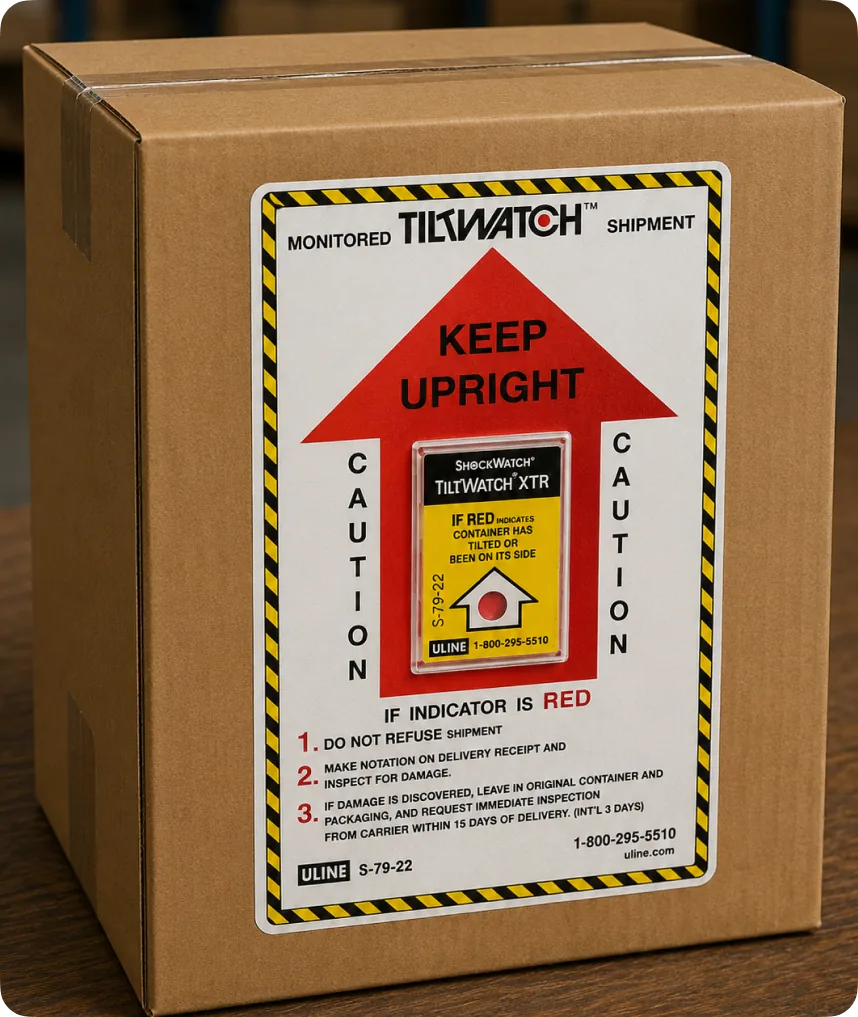
  3. The “Companion Label” Strategy: Never apply the sensor alone. It should be used in conjunction with a large, high-contrast “Upright” arrow (as seen in the provided image). This provides the handler with the instruction (the arrow) and the consequence (the sensor).
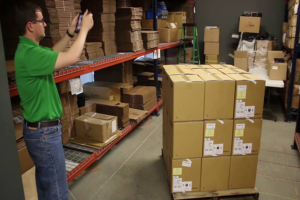
  4. Documentation and Imaging: Before a crate leaves the dock, the shipping team must take a timestamped photo of the clear (non-activated) sensor. This is a critical component of fragile cargo handling documentation, proving the item was upright when it left your control.
Shipping carton with a TiltWatch XTR tilt indicator and a red KEEP UPRIGHT arrow label

Procedures for Receiving Red Indicators

A red indicator does not automatically mean the product is broken, but it does mean the warehouse safety protocols were violated. If a shipment arrives with a red TiltWatch:

  • Do Not Refuse the Shipment: Accepting the delivery allows you to inspect the goods while the carrier is present.
  • Note the Receipt: Document the activation on the delivery receipt immediately.
  • Request Immediate Inspection: Keep the item in its original packaging until a formal damage assessment is performed.

Conclusion: Control Through Accountability

In modern logistics, you cannot manage what you do not monitor. By utilizing upright shipping requirements and active sensors, you remove the guesswork from the supply chain. These labels protect the product, but more importantly, they protect the business by providing objective data in an industry where “he-said-she-said” disputes are costly.

Share this Article
Dive Deeper