




Proudly Located at the Advanced Tech Dev Center at Georgia Tech
OUR BLOG
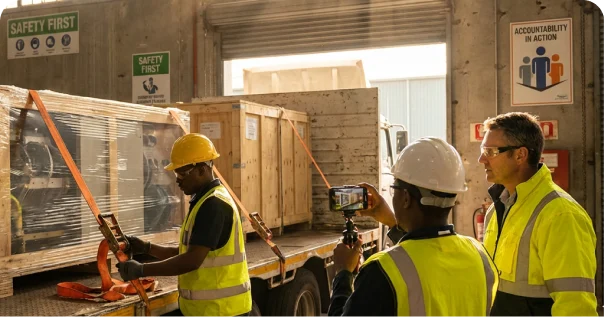
Demonstrate that showing the video of the flat bed trucks from all sides. Walk around the flat bed truck recording a video and showing all the sides and corners of the securement.

The Simple Video Rule to Protect Your Flatbed Cargo and achieve Cargo Securement Best Practices through Proof of Securement

If you run a business that moves serious equipment on flatbed trucks, you already know the stakes. That cargo isn’t just material; it’s capital. When a load shifts, even a few inches, the cost can be immediate and severe:

  • Financial Hit : Paying thousands to repair damaged machinery.
  • Customer Trust : Losing a long-term client because their shipment arrived late or was damaged.
  • Wasted Time : Hours spent on paperwork, recovery, and sorting out liability instead of generating revenue.
The solution to stopping this cycle of risk is easier than you think. Establish a proof of securement protocol that leaves zero doubt of cargo condition and supports perfect cargo securement best practices.
The best practice we see among top-tier operators is this: You must record a complete, continuous video audit of the secured load before the truck moves.

The Problem: Proving Your Load is Truly Safe

Every crew thinks the load is secured. But in the real world of transportation, you need more than confidence; you need evidence.
When a dispute arises, or damage is discovered, the question isn’t “Was the load tied down?” The question is, “Can you prove that every single tie-down meets standard, tension, and angle?” Do you have proof of securement? 
  • Protecting Your Asset Value: Expensive equipment requires certainty. A video removes the debate over whether the required cargo securement best practices were truly followed. It locks in the load’s status, protecting your balance sheet from repair costs.
  • Mitigating Customer Risk: Your customers rely on you for safe delivery. By providing a clear video record, you offer an unparalleled level of transparency and professionalism. This proactive approach builds massive customer trust and differentiates you from the competition.
  • Addressing Driver Accountability: Implementing the video requirement encourages drivers and crew members to slow down and perform a perfect, deliberate check. Knowing the camera is running drastically improves adherence to internal flatbed truck safety standards.

The Expert Protocol: Your Phone is Your Risk Manager

Using a smartphone for a video walk-around isn’t just a simple fix to prove load securement; it’s a proactive risk management strategy that pays for itself immediately.

The Three Steps to Unbeatable Securement Proof

To ensure your video is useful in preventing losses, it must be performed correctly every time:

  1. Start with the Identity (The Lock): Begin the recording by clearly showing the truck’s unit number or license plate. This is a critical step that tags the proof of securement to the exact shipment, date, and time, essential for managing large fleets.
  2. The Continuous Audit (The Walk): The operator must walk slowly and steadily around the entire flatbed truck. Focus the camera tightly on the load. You are not filming the sky, you are filming the hardware. Show the straps, the chains, the rub-strips, and the cargo edges.
  3. Verify the Tension (The Close-Up): This is the most crucial part. Briefly zoom in on every binder, ratchet, and winch point. You must clearly show that the device is locked down and that the line is under proper tension. This single close-up is what prevents cargo shift and validates your load securement diligence.

Why This Video Rule is Good for Business 

Forget the regulatory language for a moment. This video protocol is purely about smart business. It prevents money from leaking out of your company through avoidable damage and protects your most valuable asset: your customer base.
Make the 90-second video audit mandatory today. It’s the easiest way to ensure flatbed truck safety, safeguard your profits, and maintain a reputation for flawless delivery.
Share this Article
Dive Deeper