





















OUR BLOG
MIXED ITEMS ON THIS PALLET

Optimizing Mixed SKU Pallet Handling and Accuracy

Efficiency in logistics is defined not only by movement speed but by the precision of accuracy, safety, and consistency. One of the most persistent operational hurdles in modern distribution is the management of mixed item pallets, commonly referred to in the industry as “rainbow pallets.” These units combine multiple SKUs on a single pallet to optimize transport utilization and reduce freight costs, but they also introduce a significant problem in your data if not handled with extreme discipline.
While consolidation is great for the bottom line, it dramatically increases complexity during receiving and dispatch. Without structured mixed SKU pallet handling, these units quickly lead to inventory mismatches, wasted labor hours, and avoidable safety risks. Clear, high-visibility labeling is the first line of defense in maintaining warehouse inventory accuracy.

Why Mixed Pallet Labeling Matters

In a high-volume facility, handlers rely on “pattern recognition.” When a forklift operator sees a pallet, they often assume it is a monolithic load of a single product. A “MIXED ITEMS ON THIS PALLET” label serves as a critical manual override to this assumption. Without this explicit visual cue, mixed pallets are frequently scanned into the system as single-SKU units, causing a cascade of errors that can take weeks to reconcile.
Standardizing your mixed SKU pallet handling ensures that item-level verification happens at the point of entry. It forces the receiving team to stop and perform a manual break-down rather than bulk-processing the load. This simple pause is the most effective way to reduce warehouse picking errors before the stock even reaches the racking.
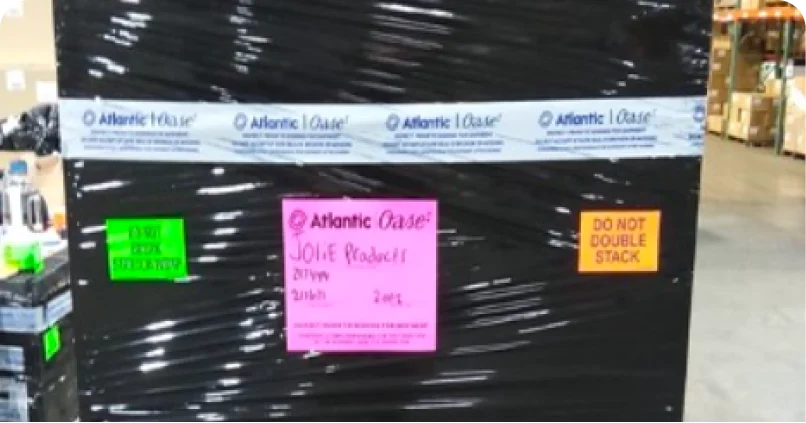
Stretch-wrapped pallet with a yellow MIXED ITEMS ON THIS PALLET warning label

Where Labeling Meets Data: The Role of ASN Verification

The physical label is only half of the solution; the other half is data synchronization. In a professional logistics environment, ASN verification logistics (Advanced Shipping Notice) must be perfectly aligned with the physical pallet. When a mixed pallet arrives, the WMS (Warehouse Management System) needs to know exactly which SKUs are buried in the middle of that stack.

If the ASN says 10 SKUs are present, but the physical pallet isn’t labeled as “Mixed,” the receiver might only scan the most visible box. This leads to “ghost inventory”, items that are physically in the building but digitally invisible. Strengthening your process ensures that every individual item on a rainbow pallet is accounted for, protecting your warehouse inventory accuracy from the dock to the customer.

Operational Best Practices for Rainbow Pallets

To keep your facility running smoothly, your mixed SKU pallet handling should follow these non-negotiable standards:

  • Dual-Side Labeling: Use high-contrast yellow labels (like the one shown above) on at least two opposing sides. This ensures that no matter how the pallet is turned in the rack, the “Mixed” status is visible to the picker.
  • The “Heavy-to-Light” Stacking Rule: Mixed pallets are notorious for uneven weight distribution. Stacking heavier SKUs at the base is a safety requirement, but it also prevents the crushing of smaller, lighter items that often leads to damage claims.
  • Dedicated Sorting Zones: Never “cross-dock” a mixed pallet without a dedicated inspection. Route these loads to a specific “Mixed SKU Zone” where they can be broken down, verified against the ASN, and re-labeled for individual put-away.
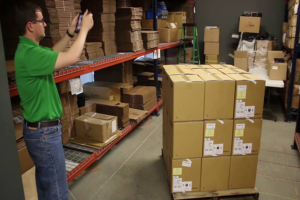
  • Visual Documentation: A manual “mixed” tag can fall off or be ignored. Capturing a photo of the pallet at the receiving dock provides irrefutable proof of the load’s condition. This “digital ASN” is the ultimate tool to reduce warehouse picking errors and resolve vendor disputes.

Conclusion

Mixed item pallets are a necessary part of a flexible supply chain, but their complexity doesn’t have to translate into chaos. By combining high-visibility labeling with rigorous ASN verification logistics, you transform a “rainbow pallet” from a liability into a manageable asset. The goal is simple: remove the guesswork. When your team knows exactly what they are looking at, your warehouse inventory accuracy remains airtight, and your operational costs stay predictable.

Share this Article
Dive Deeper